ATTACK OF THE ACORNS
If you live near Oak trees, then I don’t need to tell you that the acorn production this year was prodigious. Our house was pelted day and night with such a loud bang that I was afraid a window would break. These acorns even earned a special mention in Suzanne Klick’s weekly report from the University of Maryland Extension office. Apparently, this display occurs every 10 years or so, but I must admit that I don’t remember it ever being quite this bad. I’m sure I’ll have a boatload of seedlings to give away next spring.
BEAUTIFUL FALL FOLIAGE
Our fall foliage display is well underway, with plenty more to come. I hope you are enjoying the show.
GROUNDHOGS
Do you have a groundhog that has taken up residence near your garden? I have a few clients with groundhogs sheltering beneath their garden sheds. They may be cute to watch, but they also consume many of the plants we love. Fortunately, there is hope. For those of you who may be squeamish, stop reading, and jump to the next section. For the rest of you, the solution is easier than you might think. Place the feces of a large dog in the hole. It may take several applications, but the groundhogs will generally move on.
SPRING-FLOWERING BULBS…It’s not too late to plant your spring-flowering bulbs. As long as the ground isn’t frozen, you’re good to go. DO NOT plant with bone meal as many bulb companies still suggest. Unfortunately, this draws the unwanted attention of animals, who are quick to unearth and munch on your brand new collection. Some people do plant with a few moth balls claiming that this helps repel the unwanted visitors. If you have had success with moth balls or moth flakes, please share your observations so they can be included next time. I and at least one other person have had good luck with moth balls, but if you own a dog or cat, you may want to exercise a bit of caution.
PUTTING YOUR GARDEN TO BED FOR THE WINTER
A few easy chores now will reduce your workload in the spring and enhance your garden for the winter months ahead.
TREES and SHRUBS…Take a mental note of plants with long extending branches that could break under the weight of a wet snow. Some can be pruned a bit now, which should help. Do keep an eye on them. If we get a wet snow, you may need to brush the snow off at your earliest opportunity.
Narrow, columnar type plants such as Buxus semp. ‘Dee Runk’ and Ilex crenata ‘Sky Pencil’ will benefit from being tied spiral fashion with twine or fishing line. This will help guard against spreading.
Those of you with Hydrangea macrophylla (Bigleaf Hydrangea) may have found that very few this year flowered if at all. At this time, remove dead flowers, and prune enough so that the plant won’t be damaged by wet snow. The big pruning will come in the spring. In our area, these plants can die back to the ground when we have an early spring freeze. When this happens, all of the lush growth is brand new (first year wood). Many of the Hydrangea mac. bloom on second year wood. Hopefully, the next year you will enjoy lush flowers once again.
Newly planted Prunus laurocerasus (Cherry Laurel) is very susceptible to leaf burn in Jan/Feb/Mar. Wrapping the sides in burlap usually does the trick. After the first winter, this is no longer necessary. Even this past year, when mature specimens suffered greatly from leaf burn, new leaves pushed through forcing the damaged leaves to drop. Looking at the plants now, you’d never know they had problems in the spring.
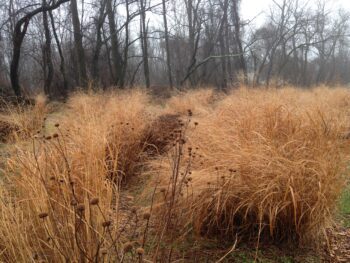
ORNAMENTAL GRASSES…As a rule, I like to keep all of my ornamental grasses throughout the winter. I love them in their dormant state as they sway with the wind. If they have flopped and are lying prostrate on the ground, then I may go ahead and chop them off. Otherwise, they stay.
PERENNIALS…Look for perennials that have gone dormant, and cut these back to about 3” ht. Look for perennials with nice basal foliage, even though the upper portions of the plant are unsightly. Cut these back to the height of the basal foliage. You might want to leave some perennials in their dormant state so that the birds can enjoy their seeds, or you simply like the way they look against the snow. Rudbeckia sp. (Black-eyed Susan) is a prime example. The black seed head is quite attractive in contrast to the white of snow. Some perennials should definitely be left alone until spring due to growth that seems to take place during the winter – Buddleia sp. (Butterfly Bush) and Perovskia sp. (Russian Sage) are in this category. There are a few that will benefit from the insulation that their dormant foliage will provide. Ferns, heuchera and geranium are among the perennials in this category, so leave their foliage alone.
ENJOYING HYDRANGEA BLOOMS ALL WINTER
Would you enjoy a large vase filled with hydrangea blooms that will last all winter? It’s easier than you think. As you prune your hydrangeas for the winter, look for flower heads that still have interesting color. For instance, some will turn pale green, pink or burgundy as they start to dry. Cut the dried blooms including stems that are at least 12” in length. Strip the stem of all foliage. Put the stems in a dry vase. That’s right – NO WATER. Initially, your flower arrangements will boast interesting color. As the winter progresses, you can expect the blooms to transition to the appearance of tan tissue paper.
If your blooms have already landed in your compost bin, just save this helpful hint for next year.
WHEN TO STOP WATERING
If you installed any new plants in the fall, do try to water at least 2x/wk for as long as you can. If you can continue through mid-December, that would be great. Unfortunately, most of us need to shut down our hose bibs for the winter so that the pipes don’t freeze and burst. Whenever the hose bibs are closed, that will be when your watering stops. Taking care of your pipes is more important than your plants. I usually shut mine down around Thanksgiving.