Baltimore Maryland Landscape Design

Creating Fine Landscapes for the Home

  • Home
  • About▾
    • Reviews
  • Process
  • Portfolio
  • Featured Plant
  • Timely Tips
    • Mildew Stain Remover Recipe
    • Poison Ivy Primer
    • Pruning Hydrangeas
  • Contact

Thank you!

May 6, 2026

After more than three decades of creating beautiful, lasting outdoor spaces, I am announcing a heartfelt retirement. Founded in 1990, I have had the privilege of transforming properties across Maryland into meaningful, personalized landscapes designed to be enjoyed for years to come.

With deep gratitude, I thank every client who placed their trust in us—inviting me into your homes, your visions, and your lives. It has been an honor to collaborate with you, listen to your ideas, and bring them to life with care, creativity, and attention to detail. The relationships built along the way have meant as much as the landscapes themselves. As this chapter comes to a close, I carry forward immense appreciation for your support, loyalty, and the opportunity to do work I truly loved.

My website will remain active for the coming months so please feel free to take advantage of saving any Timely Tips or Featured Plants while available.

With Love,

Ann Betten
Betten Landscape Design
Filed Under: Timely Tips

May 2024 Timely Tips

May 6, 2024

May 2024 Timely Tip

URGENT – PLANTS ARE STRESSED
Right now, many of my plants are stressed out. Foliage is drying out and curling. Though we had a decent amount of rain earlier in April, the latter part of the month has been extremely dry. Coupled with that has been our abrupt change in temperature from 40s and 50s to 80s and 90s. If you can, please give your plants additional water. For some of you, if your irrigation systems have yet to be turned on, this will certainly be a challenge, but just do the best you can. Pay special attention to any trees, shrubs or other plants that were installed within the past 18 months. I expect the temperatures to return to a more normal level soon. I am hopeful that most of our plants will bounce back. Even if leaves drop, it’s possible that the plant will push out new growth this season. Be patient, and give your plants plenty of TLC.

KEEP TRACK OF TEMPERATURES
Enjoy the warm summer days that often surprise us in May, but also try to remember how difficult this is for our plants. If the weather suddenly turns warm, the plants will be experiencing stress and will need more water. A good rule of thumb is a 20 degree change in temperature is significant enough to cause stress. During the growing season, try to give your plants water 3x/week, if at all possible. Just do the best you can. Remember a long, slow, steady soak is much better than a quick burst.

SPRINGTIME IS STILL A BEAUTIFUL SEASON FOR MARYLAND
I love watching everything come back to life. Of course, it’s a mad dash to keep up with the TO-DO LIST, but it always fills me with a sense of hope. My Hydrangea macrophylla have struggled again due to our wildly fluctuating temperatures in March and April. Last year, my Hyd. serrata ‘Preziosa’ came through with flying colors, just as I had predicted for the H. serrata. Unfortunately, this year my H. serrata ‘Preziosa’  looks hard hit. I’ll know more in a few weeks. For some reason, my H. mac. ‘Twist N’ Shout’ looks great. This is one of those Endless Summer varieties, blooming on first- and second-year wood. Hydrangeas might not be much to look at during the winter, but they sure put on a show all season long. You can select from among spring, summer or fall bloomers. Enjoy a smattering of all three in order to keep your garden striking for months.

TURF GRASS – THE AMERICAN LAWN
Folks are always asking me why they can’t cut their grass shorter so that they can wait two weeks between cuttings. I know that cutting weekly is a pain, but you want to keep your grass as healthy as possible. Most of us have a fescue type perennial grass that stays green year-round. For this type of grass, the accepted rule of thumb is to set your blade 3” above grade. The additional height allows your grass to withstand high heat and drought without needing much in the way of additional irrigation. Also, if you cut the grass too short, you risk cutting the quick, making it hard for the grass to recover. If you have Zoysia grass or Bermuda grass, you will be able to cut your grass a bit shorter.

PEONIES AND ANTS
Have you seen ants swarming around your peonies? This is actually a good sign. Not only are ants NOT harmful, they are an example of biological mutualism. The peonies provide nectar (food) for the ants; the ants protect the peonies from aphids, thrips, and other non-beneficial insect pests. The ants are NOT eating the thin protective layer surrounding the flower bud. This is just a popular myth.

TIME TO DIVIDE PERENNIALS
Now, is the perfect time to divide and spread out many of the perennials. Frequently, it’s as easy as placing the shovel where you want to cut the plant, and dig straight down. The mother plant stays put, and the baby plant will be given a new home. Rule of Thumb…do not change the depth of the root mass, and soak immediately after planting to remove the unwanted air pockets.

DO…spread Holly-tone within the drip edge of all your BROADLEAF EVERGREENS, and other acid-loving plants. It’s not too late.

DO…spread Plant-tone within the drip edge of all other plants, but I usually limit myself to a liberal broadcast among all of my PERENNIALS. It’s not too late.

DO lay out protective rings of DIATOMACEOUS EARTH to protect large leaved perennials from slugs. Hopefully, I’ll get around to these chores soon.

ANNUALS…Now you can buy your annuals. Try something different this year. Experiment. You can always change it later. Feeding your plants once a week can make a huge difference in their performance. Miracle-Gro, Peters Professional All Purpose Plant Food or Jack’s Classic Plant Food are options. If you use a slow release fertilizer such as Osmocote, then you may only need to apply 1x/month or less.

SPRING-FLOWERING PLANTS…Your hellebores should be deadheaded to minimize the number of volunteer seedlings. Many of their seed pods are plump and ready to explode. Spring-flowering bulbs will benefit if you remove the spent flowers and allow the foliage to remain until it turns brown.

GARDEN TOURS…Do you enjoy visiting private gardens? May and June are the best time to see most Maryland gardens. Be on the lookout for tours taking place throughout the state.

POISON IVY…Poison Ivy is already leafing out. At least now we have a fighting chance to avoid it. Please take precautions when in the vicinity of this irritating plant. Feel free to refer to the Poison Ivy Primer here on my website.

Filed Under: Timely Tips

March 2024 Timely Tips

March 6, 2024

March is here. YIKES!!!  I’m excited to see the new growth pushing out, but must admit to a bit of panic knowing all I will want to accomplish over the next 2 weeks.  So far, the leaf burn has yet to appear in my garden.  If it arrives, don’t worry.  In most cases, the plant will know to produce new leaves.  As the new growth pushes out, the brown leaves will fall.  Until that happens, the brown leaves are protecting the immature leaf buds beneath, so be sure to allow these unsightly fellows to remain.  Let’s hope that leaf burn is the only problem we encounter.  Some of the deciduous plants are still holding onto their fall foliage, such as Japanese Maple, Witchhazel (Hamamelis) and Winter Hazel (Corylopsis).  They are protecting the immature leaf buds beneath.  As soon as the young buds push out new growth, the old leaves will drop.  My winter aconite and snowdrops are in bloom, and of course the hellebores. Some of the Edgeworthias have started to bloom, and their fragrance is a welcome gift.  Be on the lookout for Cornus mas / Cornelian Cherry Dogwood.  They’ve started to bloom, and when they catch the rays, they glow with yellow blooms against red stems. Your witchhazel should be in bloom, as well.

Are the buds of your Hydrangea macrophylla nice and plump and starting to push out new growth?  If so, those buds are likely to be ruined as well.  In years past, I’ve recommended covering these hydrangeas with a sheet to try to protect the buds. DON’T BOTHER.  We experimented with some covered and some uncovered, and there was no difference in the results.  The other hydrangeas should make it through unscathed.

Most of my plants are still asleep, which for me is a good sign.  Don’t forget to harvest some of the fiddle heads from your patch of ostrich ferns.  Saute and serve with your next meal.  They are a real treat.

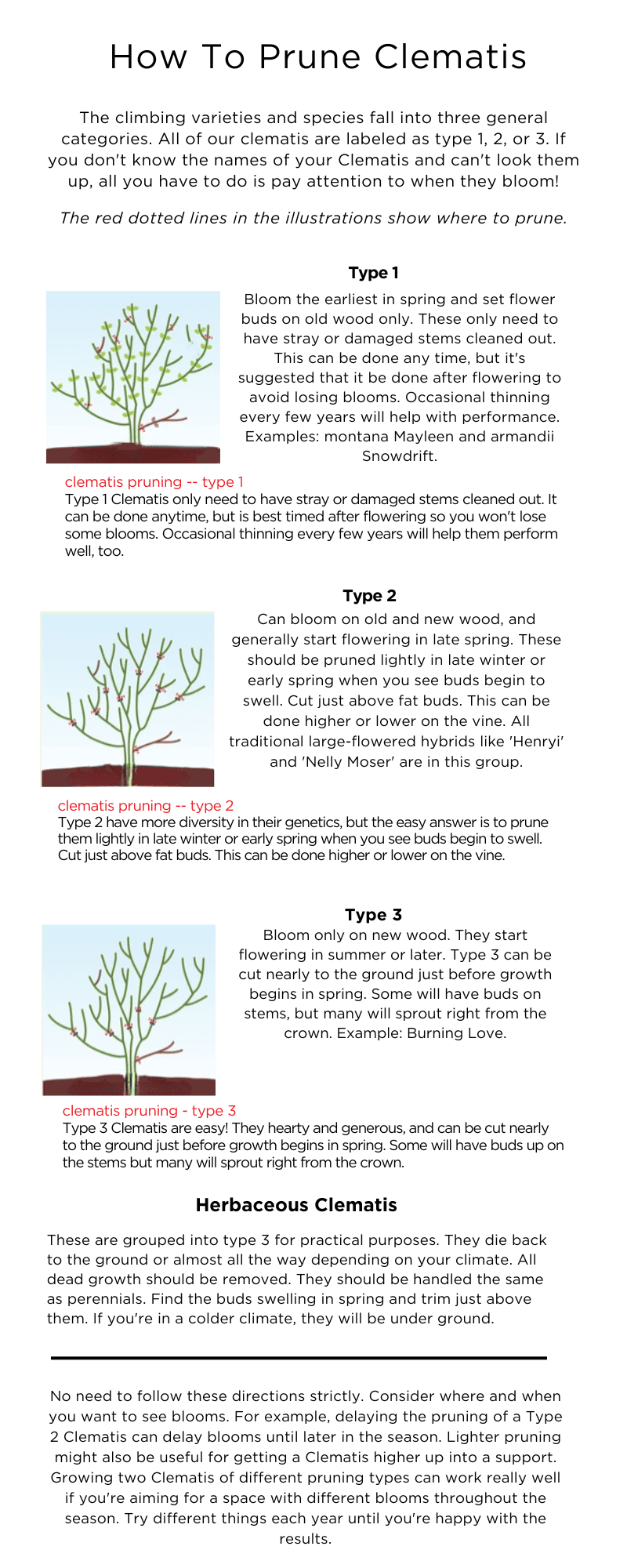
BRUSHWOOD NURSERY’S GUIDE TO PRUNING CLEMATIS…Do you wonder when and how to cut back your clematis?  The Baltimore Sun ran an article recently, but I think the information from Brushwood Nursery, Clematis Specialists is much easier to follow.  As in the Sun article, they talk about 3 groups of clematis.  If you are unsure which group you have, do contact Brushwood Nursery.  They should be able to help.  Their website is full of great information, as well. www.brushwoodnursery.com

The DEER have been voracious this past month, and will continue their destruction in March as well. Spray everything on the first sunny day we have. Be on the lookout for browsing in case you will need to take more drastic measures. Check your deer netting for holes. In one case, the deer made a slit near the bottom, and came in under the fence.

MARCH IS ALWAYS A BUSY TIME OF YEAR in the garden.  In addition to clearing out all of the debris from the winter, it is also time to cut back many plants.

CUT BACK TO 3-6” in height any ornamental grasses or perennials that became dormant over the winter.  Usually, the foliage has turned tan, brown or black.  If unable to cut back ornamental grasses this much, just do what you can.  Now is also a good time to prune the old foliage from the Helleborus hybridus, even before it turns black.  This will make the blooms even more prominent.  Last year, I tried cutting back a few of my carexes, and I was very disappointed by the effort.  The old leaves may collapse, but they also do a great job of holding in the moisture around the base of the plant.

SOME TREES AND SHRUBS WILL BENEFIT FROM SIGNIFICANT PRUNING at this time.  Annabelle Hydrangea, Hydrangea paniculata, Crepe Myrtle, Caryopteris, Hypericum, Nandina, Redtwig Dogwood and Butterfly Bush are among this group.  For the shrubs, cutting back to 12-18” in height is usually sufficient.   For the trees such as Hydrangea paniculata and Crepe Myrtle, removing the outer 12-36” can usually be tolerated.  Over time, you will determine how much pruning suits your style.  If you want to encourage your Smokebush to have a more full, shrub-like habit, cut this back to about 3-6” in height.  This will promote lots of new branches from the base, but may take 2 years before it reaches a 3’ height.  You can hard prune Nandina domestica to almost any height, and by the end of April, the new foliage will completely obscure the surgery.

DO NOT PRUNE SPRING-FLOWERING trees and shrubs until after they have bloomed.

WRAPPED EVERGREENS…If you have wrapped evergreens to protect them during the winter, do WAIT until the end of March to unwrap.  The really wet snows usually arrive in March, and cold winds will bring the leaf burn you are trying to prevent.

BOXWOOD, DWARF ALBERTA SPRUCE and ARBORVITAE rarely make it through any winter unscathed.  Branch spreading is the most common problem.  Do not waste your time trying to rejuvenate these.  The best you can do is to tie them up internally, or simply replace the plant.  Some branches have been bent for so long, and are so brittle that they will break when you attempt to tie them up.  If this happens to you, make a clean cut near the break.  If you can tolerate the plant’s new shape, then let it be.  If not, then remove the offensive specimen.

Boxwood will rejuvenate if the wood receives direct sunlight, but the process is slow.

One of the best times to TRANSPLANT SPRING-FLOWERING BULBS is while they are flowering.  With the flowers still visible, you will have a much easier time determining their new location.  The only downside is that the blooms this season may not last as long due to the trauma of being moved.  Bulbs that have migrated under shrubs should be among the first to be relocated.

!!!! BEWARE OF POISON IVY !!!!

This is one of the most dangerous times for poison ivy sufferers.  The plant has yet to leaf out, and unless you are looking at one of the distinctive, hairy vines crawling up a tree, you might not know that the vine you are pulling is really poison ivy.  My recommendation: assume all vines and root masses just below the surface are in fact poison ivy.  Many find that the rash and welts from a root abrasion is as bad, or worse than contact with the leaves.  Wear gloves, long sleeves and long pants.  Wash all clothing as soon as you come inside, and wash your body as well.  One client has found that Dawn works really well.  Be careful of the oils on gloves, shoes and boots, since they remain active for hours.  I usually ‘wash’ these items with dirt before coming inside.

IF YOU NEED HELP, it’s not too late to contact a landscape contractor to help with the spring cleanup.  A thorough cleanup, new spade-cut bed edges and a fresh layer of mulch greatly improve the ease of garden maintenance throughout the growing months.  Be careful not to smother newly emerging bulbs and perennials.  If you have a lot of perennials in your garden, postpone mulching until after the foliage has emerged.

IF YOU HAVE A QUESTION about a particular shrub or perennial in your garden, please feel free to send me an email.  I will respond promptly.  If you don’t remember the name of the plant, send me some photos.

Stay warm, and remember, you can always call if you have any questions.

Filed Under: Timely Tips

February 2024 Timely Tips

February 8, 2024

BRACING OURSELVES FOR THE REAL COLD

We finally saw some snow in January. I’m one of the few who welcomed its arrival, because I know how beneficial snow is for the health of our plants.  I always brace myself for February, expecting that to be the worst of our low temperatures.  Must admit that I’m cheating a bit, having spent the past 3 weeks in Atlanta helping out my kids with a new baby.  It will be a rude awakening when I step back into 20 degree weather.

If we see some relatively mild weather, it will be tempting to go into our gardens to start cleanup activities, getting a bit of a jump start on spring.  PLEASE HOLD BACK.  Trampling in the garden when the ground is saturated will cause increased compaction of the soil, and could reduce the oxygen available for the root systems of the plants you love.  I’m not worried about the mud on your boots, though that will be a pain. We won’t know the full effect of our winter weather until the plants actually start to leaf out.  Some of our plants’ extremities may come back to life in the spring.  And some of our plants will be dead.

If your plants are dead, instead of going into a deep depression, look at it as an opportunity to try something new.  You plant-a-holics out there know exactly what I mean.

SNOW & ICE

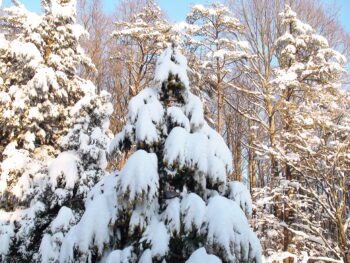
Try to brush heavy snow off of evergreen trees and shrubs.  If allowed to stay, the snow could cause abnormal spreading between branches.  Such damage is frequently seen in boxwoods, arborvitae, upright junipers and ‘Sky Pencil’ Japanese holly.  If desired, you can bind the plants with twine, fishing line or vinyl coated wire before the first snowfall.  Though somewhat visible, these ties will protect the plants without your help.  The binding can easily be removed in the spring.

Unfortunately, there is nothing you can do about ice.  If you attempt to break off the ice, you are likely to damage the plant even more.  Just hope the ice melts as quickly as possible.  In the spring, careful pruning can fix most of the winter damage.  New spring growth will take care of the rest.

THINKING ABOUT ADDING TO YOUR LANDSCAPING IN THE SPRING?

It’s not too soon to give me a call.  I’ll be happy to help you with your plans.

DO CONTACT YOUR LANDSCAPE CONTRACTOR NOW

If you know there’s a real good chance that you will have winter damage that will need attention this spring, do try to get a date on your contractor’s calendar.  The schedule for the spring will be filling up quickly, especially as soon as the weather breaks. If you have a special occasion coming up this season, do share that information with your contractor. They will usually try to accommodate these requests.

The DEER will be voracious. Spray everything on the first sunny day we have, and the temperature is above 40.  Be on the lookout for browsing in case you will need to take more drastic measures, such as wrapping your shrubs with deer mesh. Check existing deer mesh for holes. In one case, the deer made a slit near the bottom, and came in under the fence.

Stay warm, and remember, you can always give me a call if you have any questions.

Filed Under: Timely Tips

December 2023 & January 2024 Timely Tips

December 20, 2023

EVERGREENS DROPPING LEAVES

Are some of your evergreen leaves looking yellow or tan and then dropping?  No need to panic right away.  Many evergreens will lose about 30% of their foliage each year, but the timing will vary depending upon species.  We are not always paying attention, so the frequency can appear to be even less.  If you notice this change in your plants, drive around, and inspect others of the same type.  If they are also experiencing this sloughing of foliage, then you can probably relax.  If the loss of foliage is more significant, then contact someone who regularly deals with pests and diseases.  My first call is to my tree man who regularly deals with pests and diseases of my trees and shrubs.

When I am concerned, one of the first things I do is check the soil.  If it is extremely wet, then your soil conditions may have changed.  Your soil is not draining well and the excessive moisture could kill your plant.  Is it due to damaged irrigation lines?  Is there significant storm water runoff due to overflowing gutters or downspout blockages?  If there is no apparent reason for the change, then do consider transplanting the affected plants to a location with better drainage.  If you feel the need to fill in the vacated space, select a plant that can tolerate ‘wet feet’ and plant it a bit higher above grade.  For instance, we regularly plant rhododendron with the top of the root ball 3 to 4 inches above grade.

By far, my first course of action is to discover what has caused the change in soil conditions.  It is always best to proceed with the benefit of knowledge.

ALLOWING DORMANT FOLIAGE TO REMAIN

Do not be too hasty to remove dormant foliage during the winter months.  The dormant foliage can provide protection for wildlife, or added insulation at the ground level for root systems.  For some plants like Acanthus mollis / Bears’ Breeches, I purposefully gather pine branches to layer on top since we are on the northern cusp for this plant.  Ornamental grasses are among my favorites during the winter.  I love their tan color that can turn golden in the sun, and I love their movement with the wind.

PREPPING FOR THE HOLIDAYS

As we get ready for the holidays, enjoy trimming some of your evergreens and berries to bring inside.  If you planted anything late in the season, no need to water any more.  Our ground is completely saturated and the cold temperatures are keeping the moisture in.  I recommend wrapping first year broadleaf evergreens with burlap around the perimeter, or tying up your columnar evergreens with hemp in December or early January.  If the plants are right by your front door, you may want to wait until after the parties are over in early January.  DON’T FORGET TO TURN OFF AND DRAIN OUTDOOR HOSE BIBS AND HOSES.

SPRING-FLOWERING BULBS

If you still have some bulbs left in your garage, go ahead and put them in the ground.  Even if the top 2” of the soil is frozen, below that is usually fine.  DO NOT plant with Bone Meal, since the nutritional benefit is minimal while unfortunately attracting animals to your bulbs.  For tulips, I frequently plant with some mothballs to help ward off the chipmunks and squirrels who love them.

SNOW & ICE

Try to brush heavy snow off of evergreen trees and shrubs.  If allowed to stay, the snow could cause abnormal spreading between branches.  Such damage is frequently seen in boxwoods, arborvitae and upright junipers and ‘Sky Pencil’ Japanese holly.  If desired, you can bind the plants with twine before the first snowfall.  Though unsightly, it will protect the plants without your help.  The twine can easily be removed in the spring. If you use fishing line, this can remain in place all year.

For the young, broadleaf evergreens, sometimes wrapping the sides with burlap is sufficient to protect against desiccating winds.

Unfortunately, there is nothing you can do about ice.  If you attempt to break off the ice, you are likely to damage the plant even more.  Just hope the ice melts as quickly as possible.  In the spring, careful pruning can fix most of the winter damage.  New spring growth will take care of the rest.

LAWN CARE

Winter is the perfect time to broadcast a slow-release lime product to raise the alkalinity of the soil.  For most lawns, an application of lime once a year is sufficient.  If you are in a wooded area, there is always something dropping from the trees – flowers, seeds and leaves.  As these decompose, they increase the acidity of the soil, which in turn contributes to root rot in your lawn.  You may need to spread lime several times a year to counteract this natural tendency.  Try late fall before the leaves really begin to drop, mid-winter if there is no snow on the ground, and early spring before the new growth begins.  In the Maryland area, March is generally a good time for the last application.  These days, most lawn service companies are reluctant to apply this much lime due to concerns about chemical runoff.  They may only be willing to provide one or two applications per year.  It is always a good idea to have your soil tested to determine the pH level that exists.  This will help you determine the next steps.  Many lawn care companies are willing to help with the soil analysis and guidance moving forward.  If you have Southern States in your area, they may be willing to help as well.

Stay warm, stay well, and HAPPY HOLIDAYS TO ALL.

Filed Under: Timely Tips

  • 1
  • 2
  • 3
  • …
  • 5
  • Next Page »

Thank you!

After more than three decades of creating beautiful, lasting outdoor … [Read More...]

May 2024 Timely Tips

URGENT – PLANTS ARE STRESSED Right now, many of my plants are … [Read More...]

March 2024 Timely Tips

March is here. YIKES!!!  I’m excited to see the new growth pushing … [Read More...]

February 2024 Timely Tips

BRACING OURSELVES FOR THE REAL COLD We finally saw some snow in … [Read More...]

December 2023 & January 2024 Timely Tips

EVERGREENS DROPPING LEAVES Are some of your evergreen leaves … [Read More...]

November 2023 Timely Tips

ATTACK OF THE ACORNS If you live near Oak trees, then I don’t need to … [Read More...]

September 2023 Timely Tips

I’m so sad to see summer come to a close, but I do look forward to the … [Read More...]

August 2023 Timely Tips

THE HEAT WAVES HAVE BEEN BRUTAL…It’s HOT.  It’s really HOT.  And did I … [Read More...]

More Timely Tips

Ann Betten
Betten Landscape Design, LLC · PO Box 102 · Stevenson, MD 21153
Contact Us
Licensed and Insured - MHIC #71060

Member
Member, Horticultural Society of Maryland

Maryland Horticultural Society Association of Professional Landscape Designers

Best of Houzz 2021

Copyright © 2026 · Betten Landscape Design, LLC | Site Managed by SPARKS!

We use cookies to ensure that we give you the best experience on our website. If you continue to use this site we will assume that you accept these cookies.Accept