Baltimore Maryland Landscape Design

Creating Fine Landscapes for the Home

  • Home
  • About▾
    • Reviews
  • Process
  • Portfolio
  • Featured Plant
  • Timely Tips
    • Mildew Stain Remover Recipe
    • Poison Ivy Primer
    • Pruning Hydrangeas
  • Contact

November 2023 Timely Tips

November 2, 2023

ATTACK OF THE ACORNS
If you live near Oak trees, then I don’t need to tell you that the acorn production this year was prodigious.  Our house was pelted day and night with such a loud bang that I was afraid a window would break.  These acorns even earned a special mention in Suzanne Klick’s weekly report from the University of Maryland Extension office.  Apparently, this display occurs every 10 years or so, but I must admit that I don’t remember it ever being quite this bad.  I’m sure I’ll have a boatload of seedlings to give away next spring.

BEAUTIFUL FALL FOLIAGE
Our fall foliage display is well underway, with plenty more to come.  I hope you are enjoying the show.

GROUNDHOGS
Do you have a groundhog that has taken up residence near your garden?  I have a few clients with groundhogs sheltering beneath their garden sheds.  They may be cute to watch, but they also consume many of the plants we love.  Fortunately, there is hope.  For those of you who may be squeamish, stop reading, and jump to the next section.  For the rest of you, the solution is easier than you might think.  Place the feces of a large dog in the hole.  It may take several applications, but the groundhogs will generally move on.

SPRING-FLOWERING BULBS…It’s not too late to plant your spring-flowering bulbs.  As long as the ground isn’t frozen, you’re good to go.  DO NOT plant with bone meal as many bulb companies still suggest.  Unfortunately, this draws the unwanted attention of animals, who are quick to unearth and munch on your brand new collection.  Some people do plant with a few moth balls claiming that this helps repel the unwanted visitors.  If you have had success with moth balls or moth flakes, please share your observations so they can be included next time.  I and at least one other person have had good luck with moth balls, but if you own a dog or cat, you may want to exercise a bit of caution.

PUTTING YOUR GARDEN TO BED FOR THE WINTER
A few easy chores now will reduce your workload in the spring and enhance your garden for the winter months ahead.

TREES and SHRUBS…Take a mental note of plants with long extending branches that could break under the weight of a wet snow.  Some can be pruned a bit now, which should help.  Do keep an eye on them.  If we get a wet snow, you may need to brush the snow off at your earliest opportunity.

Narrow, columnar type plants such as Buxus semp. ‘Dee Runk’ and Ilex crenata ‘Sky Pencil’ will benefit from being tied spiral fashion with twine or fishing line.  This will help guard against spreading.

Those of you with Hydrangea macrophylla (Bigleaf Hydrangea) may have found that very few this year flowered if at all.  At this time, remove dead flowers, and prune enough so that the plant won’t be damaged by wet snow.  The big pruning will come in the spring.  In our area, these plants can die back to the ground when we have an early spring freeze.  When this happens, all of the lush growth is brand new (first year wood).  Many of the Hydrangea mac. bloom on second year wood.  Hopefully, the next year you will enjoy lush flowers once again.

Newly planted Prunus laurocerasus (Cherry Laurel) is very susceptible to leaf burn in Jan/Feb/Mar.  Wrapping the sides in burlap usually does the trick.  After the first winter, this is no longer necessary.  Even this past year, when mature specimens suffered greatly from leaf burn, new leaves pushed through forcing the damaged leaves to drop.  Looking at the plants now, you’d never know they had problems in the spring.

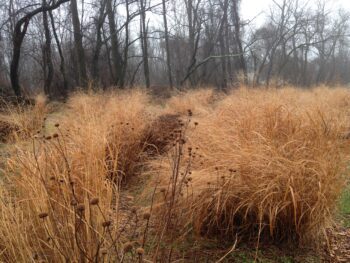
ORNAMENTAL GRASSES…As a rule, I like to keep all of my ornamental grasses throughout the winter.  I love them in their dormant state as they sway with the wind.  If they have flopped and are lying prostrate on the ground, then I may go ahead and chop them off.  Otherwise, they stay.

PERENNIALS…Look for perennials that have gone dormant, and cut these back to about 3” ht.  Look for perennials with nice basal foliage, even though the upper portions of the plant are unsightly.  Cut these back to the height of the basal foliage.  You might want to leave some perennials in their dormant state so that the birds can enjoy their seeds, or you simply like the way they look against the snow.  Rudbeckia sp. (Black-eyed Susan) is a prime example.  The black seed head is quite attractive in contrast to the white of snow.  Some perennials should definitely be left alone until spring due to growth that seems to take place during the winter – Buddleia sp. (Butterfly Bush) and Perovskia sp. (Russian Sage) are in this category.  There are a few that will benefit from the insulation that their dormant foliage will provide. Ferns, heuchera and geranium are among the perennials in this category, so leave their foliage alone.

ENJOYING HYDRANGEA BLOOMS ALL WINTER
Would you enjoy a large vase filled with hydrangea blooms that will last all winter?  It’s easier than you think.  As you prune your hydrangeas for the winter, look for flower heads that still have interesting color.  For instance, some will turn pale green, pink or burgundy as they start to dry.  Cut the dried blooms including stems that are at least 12” in length.  Strip the stem of all foliage.  Put the stems in a dry vase.  That’s right – NO WATER.  Initially, your flower arrangements will boast interesting color.  As the winter progresses, you can expect the blooms to transition to the appearance of tan tissue paper.

If your blooms have already landed in your compost bin, just save this helpful hint for next year.

WHEN TO STOP WATERING
If you installed any new plants in the fall, do try to water at least 2x/wk for as long as you can.  If you can continue through mid-December, that would be great.  Unfortunately, most of us need to shut down our hose bibs for the winter so that the pipes don’t freeze and burst.  Whenever the hose bibs are closed, that will be when your watering stops.  Taking care of your pipes is more important than your plants.  I usually shut mine down around Thanksgiving.
Filed Under: Timely Tips

September 2023 Timely Tips

September 7, 2023

I’m so sad to see summer come to a close, but I do look forward to the cooler temperatures ahead.  Our plants will appreciate the break from the heat as well.  Unfortunately, as we look around, we see evidence of the harsh summer we’ve endured.  Lawns are brown, foliage may look dry and shriveled, and sometimes it has gone dormant prematurely.  All are measures taken by the plants to survive the heat with relatively low rainfall.  As these hot and dry conditions persist, please continue to water as regularly as you can.  The shallow-rooted evergreens may not have drooping leaves, but I can assure you they are feeling the stress just as much as your Hydrangeas.

WARNING – HOLD OFF PRUNING UNTIL THE WEATHER COOLS AND DROUGHT IS OVER.  The plant’s normal response to pruning is to produce new foliage.  Unfortunately, during the drought, the plant lacks the energy necessary to support the new growth, and in trying to support the new growth, will take energy away from the recovery and maintenance of the mature growth.  This will increase the plant stress, and could cause demise.

It is during these humid summer months that we frequently notice the appearance of fungus in our mulch or near an old tree stump.  Some are actually quite beautiful, and most pose no threat to our plantings.  They are simply evidence of the biodegrading process at work.

The Spotted Lantern Fly was quite prevalent this summer throughout the Baltimore area.  Although they can cause considerable damage to our plants, there is evidence that predators have taken notice.  At an associate’s property just north of the Pennsylvania line, there was a huge infestation of SLF last summer, and almost none this summer.

PLANTING & TRANSPLANTING
The fall is a perfect time to install new plants as the temperatures begin to cool off.  Though most should be planted before November, there are quite a few deciduous trees and shrubs that can be planted even in November or December.

Now is the perfect time to divide and transplant your herbaceous Peonies and Itoh Peonies.

If TRANSPLANTING, I recommend taking the following steps:
– Hold off until at least mid-September so things will cool off a bit.
– Water the plant really well for at least 1 week prior to moving it.
– Create the largest rootball you can manage.  Have burlap and hemp on hand in case you need it to hold the soil tight to the roots.
– Pour water into the new hole; let it drain.
– Sprinkle a combination of Bio-Tone (for root growth) and Soil Moist into the hole.  You only need a very small amount of the Soil Moist.  It’s my insurance in case I neglect to water for a short period of time.
– Plant at the same depth.
– Water thoroughly to remove any air pockets.

REMOVE DAMAGED FOLIAGE
Many summer-stressed perennials will perk up during these fall months.  If you remove the old foliage, the new foliage will look like a brand new plant.  If your herbaceous Peonies have succumbed to powdery mildew, do cut them back at the base.  Other perennials with powdery mildew should be cut back to 3”, as well.  When sprucing plants up for the fall, keep in mind the effect you want during the winter months.  The black seed heads of Rudbeckia are quite striking against the snow, and the foliage of ornamental grasses is graceful blowing in the wind.  Dormant foliage will also provide another layer of insulation against the cold, and a habitat for wildlife.  It is your personal taste that matters the most.

PRUNING
September is also a good time for pruning trees and shrubs that bloom on new wood.  The new growth encouraged by pruning will have sufficient time to harden off before the winter cold settles into our area.  Plants that bloom in the spring on the previous season’s growth should be left alone until after blooming in the spring.  Most notably, this group includes Azalea, Rhododendron, Lilac, Viburnum, and most of the spring-flowering trees.  If you are unsure, please send me an email, and I’ll be happy to advise which group applies.

LAWN RENEWAL
Experts all recommend the Fall as an ideal time to renew your lawn areas.  Aerating and over-seeding is one of the more popular methods.  If you have full sun and few trees, Fall is the ideal time for you.  If you have trees, leaves may already be scattered over your lawns.  If allowed to remain, they could smother new growth.  If you have lots of trees, you may elect to renew your lawn in the spring.

Filed Under: Timely Tips

August 2023 Timely Tips

August 2, 2023

THE HEAT WAVES HAVE BEEN BRUTAL…It’s HOT.  It’s really HOT.  And did I mention that it’s HOT!!!  Summers in Baltimore are frequently uncomfortable, but this summer feels worse than normal.  And don’t forget the humidity.  The nerve of Mother Nature!!  After the somewhat drought conditions this spring, I’ve welcomed the impressive storms we’ve experienced in July.  The loss of power and subsequent debris clean up are no fun, but at least our plants received some much needed water.  Quite a few plants are having a tough time.  Don’t be too hard on yourselves if you have some plants that just don’t make it.  For many of our plants, they may simply go dormant prematurely, and will leaf out just fine next spring. The Naked Ladies (Amaryllis belladonna) will soon come into bloom, defiantly showing off their dusty pink blooms above bare stalks.  What a welcome surprise amid the heat.

WEEDING AND WATERING… Weeding is probably the most important chore for us right now.  My Japanese Stilt Grass has run rampant.  In some places, my weeds are 3 ft HT.  So don’t worry.  You’re not alone.  Just do the best you can.  It’s tough to be motivated when it’s in the 90’s with high humidity.

FUNGUS…This time of year, especially with all of our humidity, it’s quite common to see a fungus appear among our plantings.  One common type looks a bit like white foam.  It will go through various color transformations until eventually turning black and turning to dust.  The fungus is a good sign letting you know that some healthy decomposition is at play.  If it bothers you, it can be scraped off.  Otherwise, just let it be.  It will disappear on its own.

DO YOU HAVE ANNUALS IN CONTAINERS?…These plantings will benefit from an application of Miracle Gro or Jack’s Classic 1x per week, as well as some water on a daily basis.  Most only need 1x per day.  If you have hanging baskets, they may need water 2x per day.  They lose so much moisture due to exposure on all sides.

PLANTING IN AUGUST?…I recommend that you avoid planting in August.  The probability of demise is simply too great.  For most of us, it’s best to hold off until September.

PLAN FOR YOUR FALL PLANTING NOW…Fall (Sept – Nov) is one of the best times to plant.  I recommend placing your orders now before the nurseries sell out of that special plant you want.  If ordering from a catalog, make sure to specify NO DELIVERY BEFORE SEPTEMBER.  If spring flowering bulbs are on your list, many suppliers are offering discounts if you order now.

TURF GRASS….All of the turf grass experts extol the virtues of planting new grass in the fall.  If your area is in full sun without deciduous trees, then they are absolutely correct.  If you live in a wooded area, planting in the fall can feel like throwing away good money.  Just imagine the tragedy of leaves falling and smothering baby blades of new grass.  Maybe mature grass can withstand the insult, but young grass is likely to die.  If you are in a wooded area, I recommend defying the experts and planting in the spring.  Be sure to hold off on chemicals to kill weeds until after the lawn has had 3 or 4 cuts, and is strong enough to withstand the treatments.

The DROUGHT… We finally received some much needed rain in July, but we should still brace ourselves for the drought we normally experience in August. We will need to water our plants, but we should try to be as conservative as possible with our water use.  I know most of us have learned to avoid watering in the evening to avoid mold and mildew developing on the foliage.  But, when we experience extreme heat, sometimes an evening watering is actually the best way to go.  At least the water will have a chance to soak into the soil without immediate evaporation by the sun.  I frequently water between 6p-10p.  If you have a timer, you can water at 3 or 4am.  Remember, a thorough soaking for 15 – 30 minutes 2 times per week is much better than a brief spritz daily.  You want to encourage the roots to grow deep in search of water as well as nutrients.

ENJOY THE REST OF YOUR SUMMER, AND ENJOY YOUR GARDENS.

Filed Under: Timely Tips

July 2023 Timely Tips

June 27, 2023

RAIN….I don’t think I’ve ever been so happy to see some rain.  The last two weeks in June have been such a relief.  Fortunately, most has been of the slow, steady variety, therefore allowing most of it to soak into the soil.  I know it’s not nearly enough to make up for all we have lost during May and June, but I’ll take whatever I can get.  Once again, my Native Rhododendron / Rhododendron maximum didn’t start to bloom until the last week in June.  Maybe this really is the new normal for this plant.  Of course, many of the Hydrangea macrophylla buds froze in the spring, we’re all used to that by now, but the reaction of our other plants still feels new to me.  For instance, the Callicarpa, Fothergilla and Hypericum were hard hit, and very late to leaf out, but they now look as healthy as they always look in June.

If any of you have similar observations or theories about what we are experiencing, please share your thoughts.

WINEBERRY….The wild Wineberries growing at the woods edge, or sometimes out in the open, are starting to ripen.  Keep an eye out for these raspberry look alikes.  They’re sweet as sugar, and will only be around for a short time.

POWDERY MILDEW…We usually find ourselves observing Powdery Mildew toward the end of the summer, so imagine my surprise to find it over the past 2 weeks, before the rain arrived.  I first noticed it on some newly planted Spirea ‘Anthony Waterer’, and then it appeared on some Garlic Mustard.  Granted, this latter plant is considered a weed by most of us, but I have never seen it with Powdery Mildew.  This rarely causes any long term problems.  You can treat with Horticultural Oil, trim the foliage back to the height of healthy foliage, or just do nothing.

WATERING…Do you ever see those landscapers with the water tank on their trucks?  I can’t tell you how often I see these folks spraying the foliage.  They water the soil first (GOOD), but then they spend quite a bit of time spraying the foliage, hoping it will cause the drying out leaves to perk right back up.  If it is cloudy and cool, then spraying the foliage is fine, but if it is sunny or in the heat of the day, it will likely cause the foliage to burn.  If the water hits the flowers, it could hasten the wilting of the blooms.  This is why we recommend watering either very early in the morning, or late in the day/ early evening.  We also recommend this time so that the water has a chance to seep into the soil rather than immediately evaporate into the air.  Unfortunately, the commercial watering trucks don’t have that luxury, and will frequently be forced to water during the hottest portion of the day.  Make sure your professionals know that it’s best to water only the soil.

“Once my plants are established, then I no longer need to water.”  How many of us have heard this before?  For plants with substantial root systems such as trees and some shrubs, this may be true.  For plants located in the absolute perfect conditions for that particular plant, this may be true.  But for all others, supplementing with irrigation will be a huge benefit.  How will I know if my plant is in the ideal location?  You could try eliminating all artificial irrigation to see if it survives, but for many of us, this is more risk than we are willing to take.  I am much better about irrigating my garden within my deer fence than I am about the plants outside.  And it shows.  The plants outside are a bit stunted, and a number of my perennials seem to be dwindling a bit.  For instance, my Brunnera’Jack Frost’ inside the garden is huge and multiplying, while those outside seem to be dying off.

When the temperatures sore into the 90’s, do try to give a bit more water to your plants.  If you can water 3x/ week, that will be ideal.  Even if you can only supplement 1x/week, your plants will appreciate the extra help.  Remember that a thorough soaking early in the morning before 10a or late in the day after 5p is best, so that the water has time to penetrate deep into the soil before the sun beats down again.

THISTLE…has a tap root that seems to go on forever.  When pulled, you rarely get the whole plant.  There is a product on the market that targets Thistle called Lontrell, available at SiteOne Landscapes, and at other locations.  Spray on the foliage.  It will be absorbed through the vascular system into the roots, and kill the plant.  The good news is that it does NOT seem to bother other trees and shrubs.  It will damage some perennials, so do use caution when applying.

PERENNIALS THAT FLOP….Some perennials become so tall that they become top heavy, and have a tendency to flop, especially after a good rain.  Many of us resort to bamboo stakes and ties to keep them upright, but for some plants, there is an easier solution.  In June, cut the plant height in half before it starts to flower.  This encourages additional branching and a shorter ultimate height which in turn prevents the ‘flop.’  The plant may bloom a little later than normal, but it will still bloom and be lovely.  Some of the ideal plants for cutting back include: Aconitum, Aster, Amsonia, Baptisia australis, Boltonia, Coreopsis tripteris, Eupatorium (Joe Pye Weed), Phlox maculata or Phlox paniculata, Platycodon grandiflorus, Sedum ‘Autumn Joy’, and Helianthus salicifolius.  Pinching is another good option, especially for Sedum.  Snap off the top 1/3 to 1/2 of each stem by hand (they do snap off if you do this with a quick motion).  It actually does not take that long to do, and the outcome is much better than if you simply shear the plant.  If your flopping plant does not appear on this list, contact me.  I’ll be happy to look up the specifics of your plant.

JAPANESE BEETLES…need I say more.  Typically, I recommend to my clients to treat their property with grub control in the spring.  This will kill the grubs (Japanese beetle larvae) that turn into the beetles that devour our vegetation.  I cheat, and have a lawn company treat my lawn areas every year with a grub control.  Not only will this kill the grubs, but it will also reduce your mole population since they are attracted to the grubs.  If you treat your property, that’s wonderful, but if your neighbor does not, then you may still have a problem.

Unfortunately, it’s too late for that now.  The beetles are here.  So now, what can we do.

DO NOT purchase a Japanese Beetle Trap.  They simply attract everyone’s beetles to your house.

Option 1 – Go out early in the morning with a jar of soapy water.  Pluck off the beetles, and drown them in your jar.  When your jar is full, and the beetles are dead, just dump into the back of the garden and start over again.  Leave the jar outside so that it’s always handy.

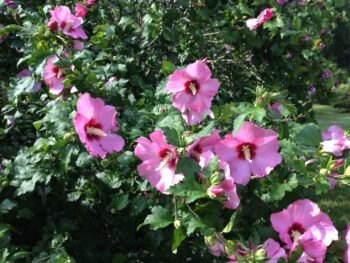
Option 2 – Dust the foliage with Sevin Dust, available at most garden centers such as Home Depot, Lowes, Valley View Farm.  One friend puts some dust in an old stocking and swings it around the foliage to be treated.  Try to avoid getting the dust on your skin, in your eyes or breathing.  Try to avoid getting the dust on flowers since it will kill many of our beneficial pollinators.  Hibiscus syriacus / Rose-of-Sharon is one of their favorites.  It’s not in bloom yet, so now would be a good time to dust.

Option 3 – Treating the soil with Nematodes in the Spring.  Nematodes are living organisms that will kill the grubs.  Go to www.gardensalive.com for reliable information.

PRUNE SPRING FLOWERING SHRUBS…. It’s not too late to prune spring flowering shrubs such as Azalea, Pieris, Rhododendron, Spirea and Viburnum.  After the flowers have dropped off, you can safely prune, and the plant will have plenty of time for the buds to set for next year.  This is also a good time to prune the Oakleaf Hydrangea, but you need to be willing to chop off some of those beautiful flowers.

DEAD HEADING PERENNIALS DOES HELP….Most perennials only bloom once a year.  After the blooms are finished, it does help to cut the flower stem down to the height of the attractive foliage.  This prevents unnecessary energy flowing to the development of seed, and instead flows into the development of the root system.  If you want to propagate your plants from seed, then leave at least a few flowers for this purpose.

COLLECTING SEED TO GROW YOUR OWN….I have trouble keeping a few of my perennials going, such as ‘Nora Barlow’ Columbine / Aquilegia ‘Nora Barlow’, and of course Foxglove / Digitalis which is a biennial.  For these, I collect the seeds before their capsules burst, and I plant them quite shallow in a designated part of my garden.  It’s in the back and out of sight.  I know where to look for the progeny of my effort, and I’m careful not to be too hasty about weeding.  The germination has worked well.  I’ve been a bit lazy about transplanting the young plants to more ideal locations later, but at least I have the option to do so.

WHEN TO LEAVE THE PERENNIALS ALONE….Many birds love the seeds produced by our plants, and sometimes the dried seed heads are very attractive in the winter.  A prime example is Black-Eyed Susan / Rudbeckia fulgida.  After the flowers are finished, you are left with the round, black center which persists all winter long, and is quite attractive against the snow.  This is a personal decision that sometimes means the choice between an aesthetic you prefer, and doing what may be more advantageous to the ecosystem you are nurturing. Through trial and error, you will figure out what works best for you.

RENEW UNSIGHTLY FOLIAGE…Foliage of our PERENNIALS can discolor during the growing season either from too much sun (Sun Scorch) or too much humidity (Powdery Mildew).  There are other afflictions as well, but the key is whether the appearance of the foliage bothers you.  If so, cut down the plant to the height of fresh new foliage or to a height of  2-3 inches if all of the foliage is bad.  Usually, the plant will generate new, healthy, disease free foliage this season.  In the rare case that foliage does not reappear, don’t panic.  There is a very good chance that the plant will still appear again next year.

HAVE A NICE SUMMER, AND ENJOY YOUR GARDENS.

Filed Under: Timely Tips Tagged With: fall foliage

June 2023 Timely Tips

June 8, 2023

DROUGHT….If you have spent any time in your garden this spring, I don’t need to tell you that we’re in the middle of a terrible drought, and it’s the beginning of June!!!  The rains we normally see in May were MIA.  The soil is extremely dry and cracked.  I finally broke down and started watering, but these conditions don’t bode well for our plants, especially those newly planted.  My advice remains the same as always – just do whatever you can.  The best would be a good soaking 3x/week between the hours of 5p – 10a.  You want to give the water plenty of time to soak deep into the soil before the heat of the sun causes it to evaporate.  If you can only water 1x/wk, it’s certainly better than nothing.  Try to avoid a short spritz since you are trying to teach your plants how to be resilient even when watering is skipped for several days.

HEUCHERA – TRIALS AND TRIBULATIONS…. Heuchera / Coral Bells have exploded on the market.  A huge number of cultivars are available with foliage that adds color and texture to your garden.  Some growers boast over 30 different cultivars to attract your creative eye, especially in the spring when the foliage is at its peak.  I’m sure you’ve been tempted by some of these, and there’s a good chance you’ve been disappointed.  My apologies to the growers, but many of these beauties just don’t seem to last very long.  I tend to torture plants in my garden with part shade conditions and very little water, so if they last in my garden, then they’re likely to be a good bet in yours (as long as you can keep the deer away).  Though rabbit resistant, the deer do enjoy nibbling.

Heuchera villosa is native to the mid-Atlantc area.  Heuchera villosa ‘Autumn Bride’ with it’s medium green foliage and white flowers in the fall may be a little boring, but it’s a strong performer.  It lasts for years and fills in nicely.  There have since been quite a few cultivars introduced that are considered a Heuchera villosa strain.  Theoretically, these should perform better for us, so try some of these first.  Years ago, I selected Heuchera v. ‘Georgia Peach’ for one of my display gardens.  I loved them, but they only lasted about 5 years, gradually dwindling to nothing.  I tried Berry Smoothie a few years ago.  Some went in the ground, and a few in containers.  The plants in the containers are about double the size of the plants in the ground.  They stay outside all winter, no insulation and no water.  This is their 3rd season in the container, and they still look great.  I have no clue why.  There are a few that have done well in my garden…Heuchera ‘Green Spice’, Heuchera ‘Citronelle’, Heuchera ‘Palace Purple’.  Heuchera ‘Rio’ has been a stellar performer so far, but this is only year 2.  Top  performers in the Mt. Cuba Center Trials include…’Citronelle’, ‘Frosted Violet’, ‘Plum Pudding’, ‘Southern Comfort’, ‘Spellbound’, ‘Autumn Bride’, ‘Bronze Wave’, ‘Caramel’, ‘Apple Crisp’.  Test some in your garden, and find out what works for you.

CAREX PENSYLVANICA….About 5 years ago, I decided to replace some of my turf grass areas with Carex pensylvanica.  The turf grass was struggling, and the lawn mowers were creating ruts that contributed to erosion.  I thought that if I could eliminate the lawn mowers, then maybe I’d be able to prevent erosion as well.  I planted plugs of Carex pensylvanica about 1” in diameter, and placed them about 1 ft On Center.  These were large areas, and I wanted to stretch my dollar.  The plants spread via below grade runners.  In the low-lying areas, most of the Carex died due to root rot.  There is now a variety that can handle the wet soil, Carex amphibiola, but I decided to simply go with an aggressive slug of a plant, Senecio aurea, instead.  Senecio aurea can tolerate wet conditions, and is frequently utilized in Rain Gardens.  The rest I kept with Carex pensylvanica.  As the plants grew, of course the weeds found purchase as well.  For 3 years, I tried to keep the weeds under control, down on my hands and knees, carefully wielding my soil knife.  Unfortunately, I would frequently unearth a new baby plant with the weed, diminishing the speed with which it would spread.  Last year, just as I was ready to throw in the towel, I decided to give it one more chance.  This time, instead of weeding, I would cut the weeds down to the 4-6” height of the Carex pensylvanica. To my surprise, this method worked.  After almost 4 years of struggling, it’s really starting to look soft and green, and gradually, the Carex is crowding out the weeds.

WEEDING…I do not recommend attempting to weed everything at one time unless you are working with a good crew.  Instead, just tackle a small area at a time.  If you are  walking around and can pull only a handful of weeds, do so, and lay them just outside the bed for disposal at a later date.  I usually only do the disposal 1x per week.  If you have 1 hour to weed, pick the most offensive area, set your timer, and simply stop when the time is up.  At least you will have started the process.  I usually have trouble stopping, and my back is always angry with me later.

POISON IVY…Watch out for the Poison Ivy while gardening.  Please check out my Poison Ivy Primer for some helpful suggestions.

HELLEBORUS….The flower stalks on Helleborus should be cut back close to the ground around the beginning of June.  If you still have flowers on your plants, do cut them back if you have the time.  A lot of energy will go to the development of seed rather than the growth of the plant.  If the seeds are allowed to disperse, you may wind up with hundreds of baby plants.  These babies are easy to transplant if desired.

PERENNIALS THAT FLOP….Some perennials become so tall that they become top heavy, and have a tendency to flop, especially after a good rain.  Many of us resort to bamboo stakes and ties to keep them upright, but for some plants, there is an easier solution.  In June, cut the plant height in half before it starts to flower.  This encourages additional branching and a shorter ultimate height which in turn prevents the ‘flop.’  The plant may bloom a little later than normal, but it will still bloom and be lovely.  Some of the ideal plants for cutting back include: Aconitum, Aster, Amsonia, Baptisia australis, Boltonia, Coreopsis tripteris, Eupatorium (Joe Pye Weed), Phlox maculata or Phlox paniculata, Platycodon grandiflorus, Sedum ‘Autumn Joy’, and Helianthus salicifolius.  Pinching is another good option, especially for Sedum.  Snap off the top 1/3 to 1/2 of each stem by hand (they do snap off if you do this with a quick motion).  It actually does not take that long to do, and the outcome is much better than if you simply shear the plant.  If your flopping plant does not appear on this list, contact me.  I’ll be happy to look up the specifics of your plant.

PERENNIALS THAT REBLOOM…AFTER DEAD HEADING….You will be able to coax an additional bloom from many of your perennials if you dead head them immediately after blooming.  This works extremely well with Echinacea / Coneflower, Leucanthemum / Shasta Daisy, Salvia, and Veronica.

PRUNE SPRING FLOWERING SHRUBS…. Now is the perfect time to prune spring flowering shrubs such as Azalea, Fothergilla, Oakleaf Hydrangea, Pieris, Rhododendron, Spiraea and Viburnum.  After the flowers have dropped off, you can safely prune, and the plant will have plenty of time for the buds to set for next year.

PERENNIALS AND HERBACEOUS SHRUBS THAT BENEFIT FROM SHEARING…Some Perennials and Herbaceous Shrubs can be pruned after flowering, and will have the appearance of  a shrub all season.  Most notably are Amsonia hubrichtii / Threadleaf Bluestar, Baptisia australis / False Indigo, and  Paeonia lactifolia (the Peonies that start fresh from the ground every year).  For the Amsonia and Baptisia, I simply shear these below the spent flowers, creating a nice soft mound.  The Peonies should be selectively pruned back to foliage you like.  With this plant, be on the lookout for Powdery Mildew.  When that appears, cut the plant back to the undamaged foliage.  At the end of the summer when the Powdery Mildew appears on my plants, I simply cut the whole plant down to the ground.

RENEW UNSIGHTLY FOLIAGE…Foliage, especially perennial foliage can discolor during the growing season either from too much sun (Sun Scorch) or too much humidity (Powdery Mildew).  There are other afflictions as well, but the key is whether the appearance of the foliage bothers you.  If so, cut down the plant to the height of fresh new foliage or 2-3 inches in height if there is none.  Usually, the plant will generate new, healthy, disease free foliage that season.  In the rare case that foliage does not reappear, don’t panic.  There is a very good chance that the plant will still appear again next year.

Filed Under: Timely Tips Tagged With: fall foliage

  • « Previous Page
  • 1
  • 2
  • 3
  • 4
  • 5
  • Next Page »

Thank you!

After more than three decades of creating beautiful, lasting outdoor … [Read More...]

May 2024 Timely Tips

URGENT – PLANTS ARE STRESSED Right now, many of my plants are … [Read More...]

March 2024 Timely Tips

March is here. YIKES!!!  I’m excited to see the new growth pushing … [Read More...]

February 2024 Timely Tips

BRACING OURSELVES FOR THE REAL COLD We finally saw some snow in … [Read More...]

December 2023 & January 2024 Timely Tips

EVERGREENS DROPPING LEAVES Are some of your evergreen leaves … [Read More...]

November 2023 Timely Tips

ATTACK OF THE ACORNS If you live near Oak trees, then I don’t need to … [Read More...]

September 2023 Timely Tips

I’m so sad to see summer come to a close, but I do look forward to the … [Read More...]

August 2023 Timely Tips

THE HEAT WAVES HAVE BEEN BRUTAL…It’s HOT.  It’s really HOT.  And did I … [Read More...]

More Timely Tips

Ann Betten
Betten Landscape Design, LLC · PO Box 102 · Stevenson, MD 21153
Contact Us
Licensed and Insured - MHIC #71060

Member
Member, Horticultural Society of Maryland

Maryland Horticultural Society Association of Professional Landscape Designers

Best of Houzz 2021

Copyright © 2026 · Betten Landscape Design, LLC | Site Managed by SPARKS!

We use cookies to ensure that we give you the best experience on our website. If you continue to use this site we will assume that you accept these cookies.Accept