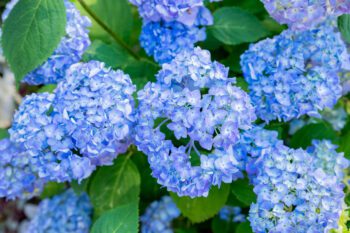
If you are like me, it’s hard to resist adding Hydrangeas to your landscape. Very few plants have such an outstanding show of blooms that persist for months. Even in their dried state, I find them an asset to the garden. In Maryland, we are fortunate to have so many options. But, when and how to prune? For this entry, I combined my experience with that of some expert landscape managers – Ron Ammon in Anne Arundel County and John Stevener in Baltimore County. I even consulted Dr. Francis Gouin’s book, Enough Said! This won’t be all of the Hydrangeas that are out there, but these are the most popular.
Hydrangea anomola var. petiolaris / Climbing Hydrangea – bloom in spring
It’s best to prune shortly after flowering in the spring, but this is such a tough plant that it can be pruned almost anytime. It can even handle significant hard pruning of several feet, and if done in the spring, you’ll find that the new growth will hide all of your cuts in no time.
Hydrangea arborescens ‘Annabelle’ / Annabelle Hydrangea – bloom in spring
Cut back to 12-18” in height in early-March. Also, remove any old, dead canes. Some folks remove small stems smaller than a pencil, but I’m lazy, and never worry about this. Cutting back in this manner encourages the production of the large flower heads we crave.
Hydrangea macrophylla / Bigleaf Hydrangea – bloom in summer
This group includes the Hortensia varieties (snowball), and Lacecap varieties that bloom on 2nd year wood. It also includes all of the ‘Endless Summer’ cultivars bred to bloom on 1st and 2nd year wood. As it turns out, the pruning is the same for all. Unfortunately, we have had several years lately when just about all of our flowering buds (apical buds) have been killed by a late freeze. When this is severe, the plant could die back to the ground and need to start all over again. Those blooming only on 2nd year wood are likely to be without flowers for the entire season, while those blooming on 1st and 2nd year wood may have nice flowers in late summer.
The best we can do is to cut back after the last freeze when we can see which buds are still healthy and plump. Prune back to the height of healthy buds. Remember that this plant will generally grow 2-3 ft in a season. All old, dead canes should be removed. Dr. Gouin also recommends, “that last year’s flowering canes should be removed as well as canes thinner than a pencil in diameter. To obtain maximum flower size with stems that are strong enough to support the flowers, thin the remaining stems so the space between them is 3” to 4” apart. This will allow strong stems to develop and space for strong new stems to emerge.”
Hydrangea paniculata / Panicle Hydrangea – bloom summer/fall
Popular cultivars include ‘Grandiflora’ (PeeGee Hydrangea), ‘Limelight’, ‘Little Lime’(a dwarf form), ‘Vanilla Strawberry’, ‘Tardiva’ just to name a few. They seem to come out with new cultivars every year.
Hard prune in the spring. March or April will be fine. If you are concerned that a heavy snow might break a drooping branch in a bad location, then by all means, cut this back a bit prior to the first snow. It is possible to hard prune these plants in the fall, but then you lose the graceful architecture for the winter months.
Hydrangea quercifolia / Oakleaf Hydrangea – bloom late spring
The best time to prune is right after flowering, probably mid-late June. Unfortunately, by doing so, you will cut off many of the flowers you normally enjoy as they age from white to pink to mauve to tissue paper brown. Since this plant blooms on the previous years growth, pruning right after flowering is really the best option. If you prune in March prior to bloom time, the plant will do well, but you won’t have many flowers.
Cut the spent blooms back to a large healthy pair of buds. To reduce size, cut back no more than a third of the plant at a time. Do not cut back all branches by a third. Blooms appear at the tips of branches so an overall trim will just repeat the pruning errors of the previous year. Cut out no more than a third of the entire branches, if you want some blooms next year. If lightly pruned in winter or early spring, you will decrease the bloom count but may get larger blooms.
Hydrangea serrata / Mountain Hydrangea – blooms later than H. macrophylla
Follow the same procedure as H. macrophylla. Hopefully, you will see a lot less dieback than you will see on H. macrophylla.