Baltimore Maryland Landscape Design

Creating Fine Landscapes for the Home

  • Home
  • About▾
    • Reviews
  • Process
  • Portfolio
  • Featured Plant
  • Timely Tips
    • Mildew Stain Remover Recipe
    • Poison Ivy Primer
    • Pruning Hydrangeas
  • Contact

February 2023 Timely Tips

February 8, 2023

WHAT HAPPENED TO THE SNOW?

As of 2/7, we have yet to see any snow. The 30 seconds at the start of the new year doesn’t count. Fortunately, we have had some rain, but that’s no substitute for the insulating and slow absorption qualities of snow. So, what will our unusual weather mean for our plants? You may be surprised to learn that what the experts fear most was the sudden severe drop in temperatures during December. It occurred much too fast for many of our plants to react. We can expect to see a significant amount of dieback, especially with respect to the evergreens. With somewhat mild weather, it’s so tempting to go into our gardens to start cleanup activities, getting a bit of a jump start on spring. PLEASE HOLD BACK. We won’t know the full effect of the dieback until the plants actually start to leaf out. Some of our plants’ extremities may come back to life in the spring. And some of our plants will be dead.

If your plants are dead, instead of going into a deep depression, look at it as an opportunity to try something new. You plant-a-holics out there know exactly what I mean.

One helpful source for this update is the….Volunteer Gardener. For further information and a discussion of the biology involved, please go to the end of this entry.

SNOW & ICE

Try to brush heavy snow off of evergreen trees and shrubs. If allowed to stay, the snow could cause abnormal spreading between branches. Such damage is frequently seen in Boxwoods, Arborvitae and Upright Junipers and ‘Sky Pencil’ Japanese Holly. If desired, you can bind the plants with twine, fishing line or vinyl coated wire before the first snowfall. Though somewhat visible, it will protect the plants without your help. The binding can easily be removed in the spring.

Unfortunately, there is nothing you can do about ice. If you attempt to break off the ice, you are likely to damage the plant even more. Just hope the ice melts as quickly as possible. In the spring, careful pruning can fix most of the winter damage. New spring growth will take care of the rest.

THINKING ABOUT ADDING TO YOUR LANDSCAPING IN THE SPRING? It’s not too soon to give me a call. I’ll be happy to help you with your plans.

DO CONTACT YOUR LANDSCAPE CONTRACTOR NOW. If you know there’s a real good chance that you will have winter damage that will need attention this spring, do try to get a date on your contractor’s schedule. The schedule for the spring will be filling up quickly, especially as soon as the weather breaks. If you have a special occasion coming up this season, do share that information with your contractor. They will usually try to accommodate these requests.

The DEER will be voracious. Spray everything on the first sunny day we have, and the temperature is above 40. Be on the lookout for browsing in case you will need to take more drastic measures, such as wrapping your shrubs with deer mesh. Check existing deer mesh for holes. In one case, the deer made a slit near the bottom, and came in under the fence.

Stay warm, and remember, you can always call if you have any questions.

THE FULL DISCUSSION FROM THE VOLUNTEER GARDENER…

Dramatic Winter Damage Video – from Volunteer Gardener

“Many friends are beginning to post photos of damage to plants, like these Aucuba in my garden, from this weekend’s record cold. The real problem for most plants was not the cold itself, but the extreme and rapid drop in temperature. At my house, it dropped from 53 degrees at 3 p.m. to 0 degrees at 3 a.m. When this happens, plants–and especially broadleaf evergreens– don’t have time to react. Normally, they would draw more water down into their roots, increase the concentration of sugars in their leaves (antifreeze for evergreens), or both. This helps to keep ice crystals from forming inside of plant cells.

In a flash freeze like we experienced this week, the plants don’t have time to react and the water inside the cells of the plants freezes. Ice crystals are pointed and sharp and, since water expands as it freezes, push outward puncturing the cell walls as they go. Enough cell damage = tissue damage. Enough tissue damage = plant damage/death (sometimes partial, sometimes total, depending on the plant and the situation). Leaves usually take the brunt of the damage, but in some plants, stems may also be damaged. This damage usually takes longer to show up; sometimes months. The key, now, is patience. Do not prune. Wait. The full extent of this damage is not going to be known until spring, and maybe beyond. If the stems have not been damaged, many plants will leaf back out. Even so, it may take a full season or two for some plants to recover. We will also see damage in deciduous trees and shrubs. You can count on it. Thin-barked species like crape myrtles, Japanese maples, and others may have suffered damage that will be completely hidden until they try to leaf out in spring. Small stems, less than 3/4″ or so in diameter may have been killed outright in more tender species. You may also see bark damage in the form of splits or cracks running up the stems/trunks, or dead patches of bark (which usually turns black). Depending on the extent and location of this damage, you may see the death of some or all of the stems or, in the worst case, tree trunks and the resulting death of the tree. In a similar situation in Tennessee in the late 80’s, mature ‘Nellie R. Stevens’ hollies (and many other species, both native and non), crape myrtle, etc. were killed completely to the ground. Don’t be surprised if it happens again, especially on recently planted and/or younger and less-established plants.”

Additionally, NC Cooperative Extension program is hosting a zoom webinar on Vascular Streak Dieback on Feb. 27th 2023 from 9:30am – 12pm. I’ve attached the QR code and brochure here if you’d like to join.
Filed Under: Timely Tips Tagged With: fall foliage

November 2022 Timely Tips

October 31, 2022

November Timely Tips

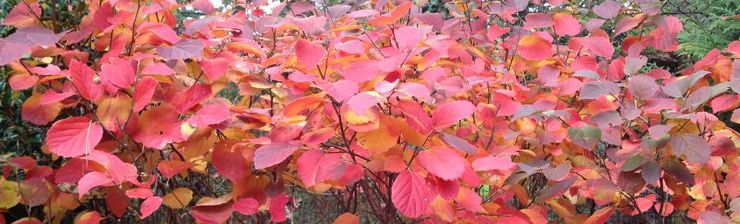
BEAUTIFUL FALL FOLIAGE

Our beautiful Fall Foliage is just getting started in my neck of the woods.  I’m keeping my fingers crossed for a spectacular display.

Our cooling temperatures have been great for planting, but as of late, not much rain. Be sure to give your new plantings plenty of water.  Due to the cooler temperatures, at least it won’t evaporate right away.  You may only need to water 2x/wk instead of 3x/wk.  Check the soil.  If it’s cool and damp, hold off watering.  If we have half a day of steady, gentle rain, then you can skip a day of watering.

SPRING FLOWERING BULBS…It’s not too late to plant your spring flowering bulbs.  As long as the ground isn’t frozen, you’re good to go.  DO NOT plant with Bone Meal as many bulb companies still suggest.  Unfortunately, this draws the unwanted attention of animals quick to unearth and munch on your brand new collection.  Some people do plant with a few moth balls claiming that this helps repel the unwanted visitors.  If you have had success with moth balls or moth flakes, please share your observations so they can be included next time.

PUTTING YOUR GARDEN TO BED FOR THE WINTER

A few easy chores now will reduce your workload in the spring, and enhance your garden for the winter months ahead.

TREES and SHRUBS…Take a mental note of plants with long extending branches that could break under the weight of a wet snow.  Some can be pruned a bit now, which should help.  Do keep an eye on them.  If we get a wet snow, you may need to brush the snow off at your earliest opportunity.

Narrow, columnar type plants such as Buxus semp. ‘Dee Runk’ and Ilex crenata ‘Sky Pencil’ will benefit from being tied spiral fashion with twine.  This will help guard against spreading.

Those of you with Hydrangea macrophylla / Bigleaf Hydrangea may have found that very few flowered if at all.  At this time, remove dead flowers, and prune enough so that the plant won’t be damaged by wet snow.  The big pruning will come in the spring.  In our area, these plants can die back to the ground when we have an early spring freeze.  When this happens, all of the lush growth is brand new (first year wood).  Many of the Hydrangea mac. bloom on second year wood.  Hopefully, the next year you will enjoy lush flowers once again.

Newly planted Prunus laurocerasus / Cherry Laurel is very susceptible to leaf burn in Jan/Feb/Mar.  Wrapping the sides in burlap usually does the trick.  After the first winter, this is no longer necessary.  Even this past year when mature specimens suffered greatly from leaf burn, new leaves pushed through forcing the damaged leaves to drop.  Looking at the plants now, you’d never know they had problems in the spring.

ORNAMENTAL GRASSES…As a rule, I like to keep all my ornamental grasses throughout the winter.  I love them in their dormant state as they sway with the wind.  If they have flopped and are lying prostrate on the ground, then I may go ahead and chop them off.  Otherwise, they stay.

PERENNIALS…Look for perennials that have gone dormant, and cut these back to about 3” in ht.  Look for perennials with nice basal foliage, but the upper portions of the plant are unsightly.  Cut these back to the height of the basal foliage.  Some perennials you may want to leave in their dormant state so that the birds can enjoy their seeds, or you simply like the way they look against the snow.  Rudbeckia sp. / Black-eyed Susan is a prime example.  The black seed head is quite attractive in contrast to the white of snow.  Some perennials should definitely be left alone until spring due to growth that seems to take place during the winter – Buddleia sp. / Butterfly Bush and Perovskia / Russian Sage are in this category.  There are a few that will benefit from the insulation that their dormant foliage will provide. Ferns, Heuchera and Geranium are among the perennials in this category, so leave their foliage alone.

TROPICAL BULBS…Do you have Canna Lily or Elephant Ears in your garden?  You can rescue them now for planting next year, and they should double in quantity as well.  Some clients and the kind folks at The Perennial Farm have contributed to this section.

CANNA LILY…Cut foliage to about 3” above soil.  Cut foliage can go to the compost heap.  Dig up the rhizomes, and once the dirt has dried, brush them off.  The goal is to keep them cold, but not frozen, and avoid rot from too much moisture.  First choice is a wood box or paper bag. Second choice is a plastic tub, but use newspaper instead of the plastic lid.  Layer with leaves, peat, sawdust, or even shreadded paper.  Spread out bulbs so there is at least a little space between each bulb.  Top with the layering material.  Store in a cool, dark place.  A garage usually works well.

COLOCASIA ESCULATA / ELEPHANT EARS…Follow the same procedure as above.  One client never bothers with the layering, and they still survive and multiply well.

WHEN TO STOP WATERING

If you installed any new plants in the fall, do try to water at least 2x/wk for as long as you can.  If you can continue through mid-December, that would be great.  Unfortunately, most of us need to shut down our hose bibs for the winter so that the pipes don’t freeze and burst.  Whenever the hose bibs are closed, that will be when your watering stops.  Taking care of your pipes is more important than your plants.  I usually shut mine down around Thanksgiving.


Filed Under: Timely Tips Tagged With: fall foliage

  • « Previous Page
  • 1
  • 2
Ann Betten
Betten Landscape Design, LLC · PO Box 102 · Stevenson, MD 21153
Contact Us
Licensed and Insured - MHIC #71060

Member
Member, Horticultural Society of Maryland

Maryland Horticultural Society Association of Professional Landscape Designers

Best of Houzz 2021

Copyright © 2026 · Betten Landscape Design, LLC | Site Managed by SPARKS!

We use cookies to ensure that we give you the best experience on our website. If you continue to use this site we will assume that you accept these cookies.Accept